

The High-Stakes Reality of Florida Engineering
For developers, architects, and business owners in the Tampa Bay area, installing a shade structure isn’t just about aesthetics—it’s about rigorous engineering. Florida has some of the most stringent building codes in the world due to our status as a high-velocity hurricane zone. Understanding Florida Building Code shade requirements is the first step in a successful commercial installation.
When a project moves from a simple backyard “DIY” project to a commercial installation on a hotel rooftop or a school playground, the legal and safety requirements shift dramatically. In the eyes of the Florida Building Code (FBC), a permanent tensile structure is a “building” that must adhere to the same safety standards as the walls of the venue itself.
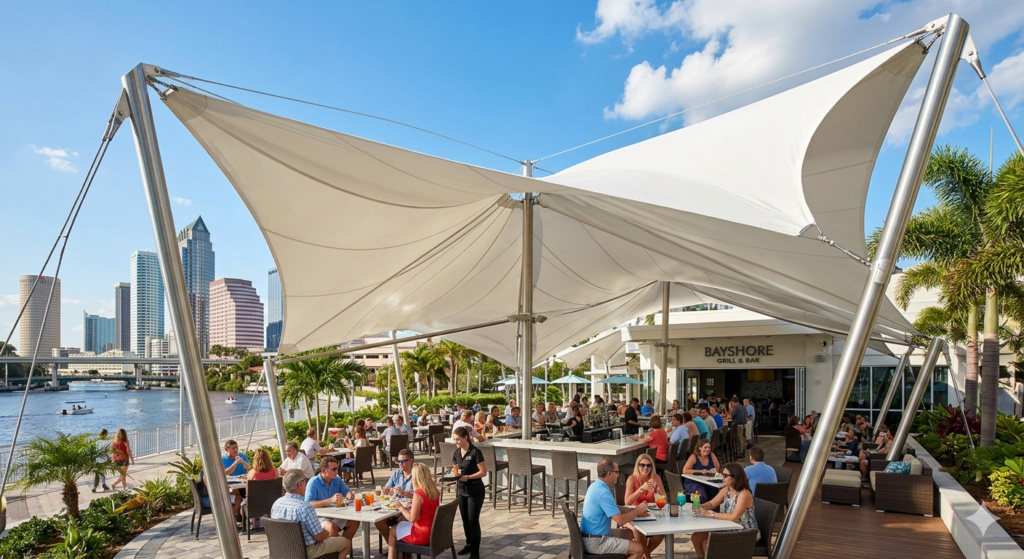
The Importance of ASCE 7-22 Standards
In Florida, all permanent structures must be designed to withstand specific wind speeds. Depending on the exact location in Tampa, Clearwater, or St. Petersburg, a structure may need to be engineered for wind gusts ranging from 140 to 160 mph. These aren’t arbitrary numbers; they are based on the ASCE 7-22 standards, which dictate how structures must respond to extreme wind pressure.
At Shady Sails, we don’t just “hang fabric”. Every commercial project involves structural calculations that ensure the steel columns, footings, and fabric tension can handle the immense pressure of a tropical storm system. For instance, a 20×20 shade sail can act like a giant wing in a 100 mph gust, exerting several tons of “uplift” on its mounting points. Without professional engineering, that sail can become a projectile, causing catastrophic damage to property or life.
Permitting: Why Professional Installation is Mandatory
Many commercial property owners are surprised to learn that a permanent shade sail requires a building permit just like a building addition. This process involves:
- Signed and sealed engineering drawings from a Florida-licensed P.E. (Professional Engineer).
- Site plans showing proximity to property lines, existing structures, and underground utilities.
- Soil analysis to ensure concrete footings are deep and heavy enough to prevent “uplift” or “overturning” during a storm.
- Fabric fire ratings ensuring the material meets NFPA 701 standards for flame retardancy, a critical requirement for public gathering spaces.
Skipping the permit process might save time initially, but it leaves the business owner liable. If a storm damages an unpermitted structure, insurance companies will often deny the claim. Furthermore, local code enforcement can issue “Stop Work” orders or daily fines until the structure is brought into compliance or removed entirely.
The “Uplift” Factor: Engineering Below the Ground
The part of a Shady Sails installation that people rarely see is often the most important: the footings. In the sandy soil of the Tampa Bay area, engineering for “uplift” is the primary challenge. Because a shade sail naturally wants to fly upward when wind gets underneath it, we often have to pour footings that are six to eight feet deep, reinforced with heavy rebar cages.
This is the difference between a “shade sail” bought online and a “tensile membrane structure” from Shady Sails. Our structures are built to stay in the ground, even when the weather turns violent. We calculate the exact volume of concrete needed to act as a counterweight against the square footage of the fabric above.
Materials Matter: HDPE vs. Vinyl-Coated Polyester
Code compliance also extends to the materials used. In a commercial setting, we prioritize materials that offer both longevity and safety. High-Density Polyethylene (HDPE) mesh is our preferred choice for most Florida installations because it is breathable. This breathability is a safety feature: it allows wind to pass through the fabric, significantly reducing the “sail effect” and the total wind load on the columns.
However, for projects requiring 100% waterproof protection, we utilize PVC-coated polyester or PTFE-coated glass fiber. These materials require even more robust engineering because they do not breathe, meaning the columns and footings must be designed to withstand the full, unmitigated force of the wind.
Why Shady Sails is the Professional Choice
Navigating the bureaucracy of Florida’s building departments—from the City of Tampa to Hillsborough and Pinellas Counties—is a full-time job. We handle the entire lifecycle of the project, from the initial wind-load analysis to the final inspection.
When you work with Shady Sails, you are getting a structure that is:
- Legally compliant: Fully permitted and built to current Florida Building Codes.
- Safety-first: Engineered by licensed professionals who understand local wind patterns.
- Insured: Built to standards that satisfy commercial insurance underwriters.
In a state where “hurricane season” is a six-month reality, there is no room for shortcuts. Shady Sails provides the peace of mind that your investment—and your customers—are protected by world-class engineering.